AI Visibility: How to Get Your Business Cited by ChatGPT, Perplexity, and Google AI Overviews
AI visibility is the practice of getting your business named and cited inside the answers that AI engines like ChatGPT, Perplexity, and Google AI Overviews generate. As buyers shift from scanning ten blue links to reading one synthesised answer, being the source that answer quotes is becoming more valuable than ranking beneath it. This guide explains how AI engines choose what to cite, and the steps that put your business inside those answers.
What is AI visibility?
AI visibility is the discipline of making your business the source AI engines reference when they answer a question. It is also called Generative Engine Optimisation (GEO) and Answer Engine Optimisation (AEO). Traditional SEO earns you a position in a list of links. AI visibility earns you a mention inside the answer itself.
The difference matters. A buyer asking ChatGPT or Google’s AI Overview “who are the best B2B SEO agencies in the UK” no longer sees ten links to choose from. They see a short answer that names a handful of businesses. If your firm is not in that answer, you are not in the consideration set, and the buyer may never reach a page where you could have ranked.
Why AI visibility matters now
Search behaviour has changed. Google AI Overviews answer many queries on the results page, and tools like ChatGPT and Perplexity have become research and discovery engines in their own right. The click is becoming optional, which means citation share, how often you are named as a source, is now a more durable measure of visibility than raw ranking position.
There is a second reason this is urgent. The engines do not agree with each other. The sources Google’s AI Overview cites, the sources ChatGPT cites, and the sources Perplexity cites overlap only partially. Visibility has to be built across engines, not won on one and assumed everywhere.
For founder-led B2B service businesses, this is an authority play. The firm that gets named as the answer wins the buyer’s attention before a competitor is even seen.
How AI engines decide what to cite
AI engines do not cite at random. They favour sources that are easy to extract from, clearly understood, and corroborated elsewhere. Seven factors carry most of the weight. For a deeper look at how AI search engines choose which sources to cite, see our full breakdown.
- Clear, extractable answers. Engines lift self-contained statements that answer a question directly. An answer buried under preamble does not get extracted.
- Question-shaped structure. Headings phrased as the questions people actually ask, with the answer in the first sentence beneath, are far easier for an engine to use.
- Entity clarity and consistency. The engine needs to understand what your business is, where it operates, and what it does, stated consistently across your site, your Google Business Profile, LinkedIn, and directories. Contradictory or thin information makes you a risky source to cite.
- Corroboration across the web. Engines prefer claims and businesses that are confirmed in more than one place. Mentions, reviews, and references on sites other than your own raise your citation odds.
- Authority and trust signals. Demonstrable experience, named authors, awards, case studies, and a visible track record. Anonymous or thin content is rarely cited for commercial topics.
- Structured data. Schema helps engines parse what your content is and removes ambiguity about your business.
- Freshness. For fast-moving topics, current content is preferred over content that has not been touched in years.
How to get your business cited
Earning AI citations is a build, not a switch. These are the moves that compound.
- Lead every page with the answer. Put a direct, quotable answer in the first two sentences under each heading, then expand.
- Build content around real questions. Use the exact phrasing your buyers type as headings, each followed by a clean answer, and add a dedicated FAQ section.
- Make your entity unambiguous. Write one clear description of who you are and what you do, and repeat it consistently across your website, Google Business Profile, LinkedIn, and every directory you appear in.
- Earn third-party mentions. Get named in relevant articles, directories, podcasts, and industry roundups. Corroboration off your own domain is often what tips a borderline citation in your favour.
- Add structured data. Organisation, LocalBusiness, and Article schema so engines can parse your business and content cleanly.
- Own the whole topic. Cover your category in depth rather than chasing single keywords, so you become the most complete source an engine can draw on.
- Publish across engines and measure. Ask ChatGPT, Perplexity, Google AI Overviews, Claude, and Gemini the questions your buyers ask, see where you appear, fix the gaps, and re-check monthly.
This is the work we build for clients as search authority and AI visibility infrastructure. For a step-by-step on one engine, read how to appear in ChatGPT and Perplexity search results.
AEO, GEO, and SEO: what is the difference?
The three disciplines overlap, and the same foundations feed all of them.
- SEO earns rankings in traditional search results.
- AEO (Answer Engine Optimisation) earns the answer in answer engines and featured snippets.
- GEO (Generative Engine Optimisation) earns citations inside AI-generated answers.
Clear answers, strong authority, and clean structure serve all three at once. Built together, they compound. This is why AI visibility is not a replacement for SEO, it is the next layer on top of it.
Frequently asked questions
What is generative engine optimisation (GEO)?
Generative engine optimisation is the practice of optimising your content and entity signals so that AI engines cite your business inside the answers they generate. It extends SEO from ranking links to being named as a trusted source.
How is AI visibility different from SEO?
SEO earns a position in a list of links the user still has to click. AI visibility earns a mention inside the answer the user reads, often without any click at all. They share foundations but optimise for different end points.
How do I know if ChatGPT or Perplexity is citing my business?
Ask the engines directly. Pose the questions your buyers would ask about your category, and see whether your business is named or cited. Repeat across ChatGPT, Perplexity, Google AI Overviews, Claude, and Gemini, and track it monthly, because the engines do not agree with one another.
How long does it take to appear in AI Overviews or AI answers?
It varies. AI engines reflect what is already established about your business across the web, so the timeline depends on your existing authority, content depth, and consistency. It is an ongoing build rather than a one-time setting you switch on.
Can you guarantee AI citations?
No. No one can guarantee what a generative engine will cite, and any firm that promises it is overselling. What can be engineered are the conditions that make your business the most citable source in your category.
How much does AI visibility work cost?
It depends on your starting authority, how competitive your category is, and how much content and entity work is required. The fastest way to a clear figure is to assess where you stand now.
See how visible your business is to AI engines and search.
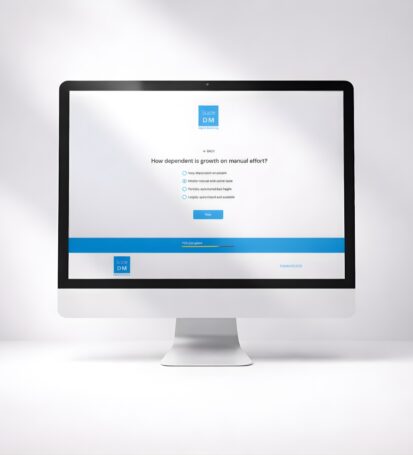
The AI Revenue Scorecard shows where you stand and where the gaps are, in a few minutes.
Scale DM builds search authority and AI visibility infrastructure for founder-led B2B service businesses across the UK. Explore our SEO and AI visibility services or AI revenue systems.