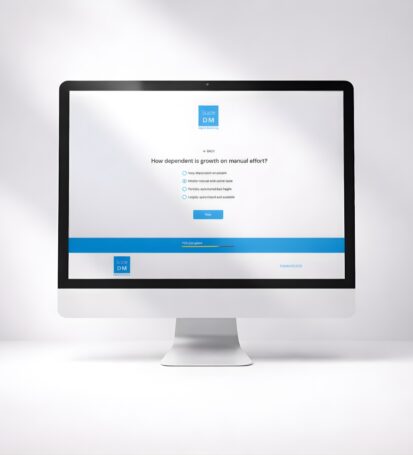
Qualification should accelerate a good sales conversation, not create another barrier.
AI lead qualification uses automation and machine intelligence to assess an enquiry, collect missing information, assign a score and route the prospect to the right next step.
Done properly, it gives sales teams faster context and prevents strong opportunities from sitting in a shared inbox.
Done badly, it becomes an opaque gatekeeper that rejects potential buyers, frustrates prospects and reproduces bias at scale.
The design standard is therefore simple: use AI to create speed, consistency and context. Keep people responsible for judgement and significant decisions.
The short answer
An AI lead qualification system should:
- Capture the enquiry and its source.
- Ask only the questions needed for the next decision.
- Assess fit, intent, urgency, authority and risk.
- Create or update the CRM record.
- Route the lead to sales, nurture, self-service or human review.
- Learn from downstream outcomes.
The system should explain what it is doing, minimise unnecessary data collection and provide a human path where the decision matters.
Qualification is not the same as scoring
A score is one output. Qualification is the wider process.
A useful qualification process answers three questions:
- Is this organisation a plausible fit?
- Is there a real and current reason to act?
- What should happen next?
A lead can score highly on company size but have no active need. Another can be smaller than the ideal profile but have urgent intent, a strong use case and a clear decision process.
The system should therefore combine several dimensions rather than rely on one threshold.
The five dimensions of an AI lead qualification model
1. Fit
Fit describes whether the prospect resembles the organisations the business is designed to serve.
Possible signals include:
- Sector.
- Company size or turnover band.
- Location.
- Service requirement.
- Existing technology or operating model.
- Regulatory or delivery constraints.
Fit should be based on evidence from successful clients and commercial strategy, not assumptions copied from another company’s framework.
2. Intent
Intent describes what the prospect is trying to achieve and how actively they are researching a solution.
Signals can include:
- The wording of the enquiry.
- Pages viewed before conversion.
- A requested service or outcome.
- Questions asked in chat.
- Repeat visits.
- Engagement with a diagnostic or calculator.
Intent is often more useful than demographic fit because it reveals why the buyer is acting now.
3. Urgency
Urgency affects routing and response time.
The system may identify:
- A fixed launch or renewal date.
- A pipeline gap.
- A compliance deadline.
- An operational failure.
- A contract ending.
- A need to replace a supplier.
An urgent lead does not automatically deserve a sales call. It deserves a fast and appropriate response.
4. Authority and process
In B2B sales, the contact may be a decision-maker, influencer, researcher or user.
Qualification can collect:
- Role and responsibility.
- Who else is involved.
- Whether budget has been allocated.
- How the decision will be approved.
- Which alternatives are being considered.
The system should not treat a non-decision-maker as worthless. Many complex sales begin with an internal researcher.
5. Risk and exceptions
Risk signals determine when automation should stop and a person should review the case.
Examples include:
- Sensitive personal data.
- Vulnerable customers.
- A regulated product or service.
- Unusual commercial terms.
- Conflicting answers.
- Low confidence in the extracted information.
An exception route protects both the prospect and the organisation.
A practical scoring model
A simple model can use weighted points.
- Dimension: Fit | Example measure: Sector, size, location and service alignment | Maximum score: 30
- Dimension: Intent | Example measure: Specific problem, relevant page behaviour and requested action | Maximum score: 25
- Dimension: Urgency | Example measure: Defined timing or cost of delay | Maximum score: 20
- Dimension: Authority | Example measure: Role, access to decision process and stakeholder clarity | Maximum score: 15
- Dimension: Data confidence | Example measure: Completeness and consistency of information | Maximum score: 10
- Dimension: Total | Maximum score: 100
Possible routes:
- 75 to 100: priority human follow-up.
- 50 to 74: standard sales follow-up or diagnostic.
- 25 to 49: targeted nurture or self-service resource.
- Below 25: review, redirect or low-frequency nurture.
These numbers are only a starting point. The system must be calibrated against actual closed, lost and disqualified opportunities.
Conversational AI versus static forms
Static forms are useful when:
- The information required is predictable.
- The decision is simple.
- Buyers are willing to complete the fields.
- The business needs a controlled data format.
Conversational AI is useful when:
- The prospect may describe the problem in different ways.
- Follow-up questions depend on previous answers.
- The buyer needs clarification before continuing.
- The business wants to qualify and educate at the same time.
The strongest journey may combine both. A short form captures essential details. A conversational layer asks relevant follow-up questions and explains the next step.
The end-to-end workflow
Step 1: Capture
Bring enquiries from forms, email, chat, paid campaigns and referrals into one intake process.
Step 2: Enrich
Add reliable company or account information where permitted and useful. Avoid collecting data simply because it is available.
Step 3: Ask
Ask the minimum number of questions needed to determine the correct next action.
Step 4: Score
Apply transparent rules and, where AI classification is used, store the reason or evidence behind the score.
Step 5: Route
Assign the lead, create the task, set the response deadline and trigger the right communication.
Step 6: Review
Send uncertain, sensitive or high-impact cases to an authorised person.
Step 7: Learn
Compare scores with downstream results. Which leads booked, attended, progressed and closed? Adjust the model using real commercial outcomes.
Data protection and human oversight
The ICO distinguishes profiling from solely automated decisions that have legal or similarly significant effects.
A typical B2B routing score may not have that level of effect, but the organisation still needs to comply with UK data protection principles. That includes:
- A lawful basis for processing.
- Clear privacy information.
- Data minimisation.
- Accurate data.
- Defined retention periods.
- Security and access controls.
- A process for objections or corrections where relevant.
Where an automated decision could significantly affect an individual, stronger safeguards may apply, including meaningful information, human intervention and the ability to challenge the outcome.
The practical commercial principle is equally important. Do not let a model silently reject a high-value opportunity when a short human review could resolve uncertainty.
Metrics that show whether the system works
Track:
- First-response time.
- Time to owner assignment.
- Qualification completion rate.
- Sales acceptance rate.
- Booked-call rate.
- Show rate.
- Opportunity conversion.
- False-positive rate.
- False-negative rate.
- Revenue by score band.
A qualification system is not successful because it disqualifies more leads. It is successful when sales spends more time on the right conversations and fewer valuable enquiries are lost.
Common failure points
Too many questions
The system asks for everything the business might ever want instead of what is needed for the next decision.
Hidden logic
Sales cannot explain why a lead received a score, so the team stops trusting it.
Static rules
The model is never recalibrated against won and lost business.
No exception path
Unusual prospects are forced into a route that does not fit.
Automation without service levels
The lead is scored correctly but still waits because no owner, deadline or escalation rule exists.
Treating low score as no value
A lead may not be ready now but can still enter a useful nurture path.
A focused implementation plan
- Review the last 50 to 100 enquiries and outcomes.
- Identify the signals that separated good opportunities from poor fits.
- Define the minimum qualification questions.
- Build a transparent first version with human review.
- Connect it to CRM ownership and response deadlines.
- Test the system against historical cases.
- Deploy to one channel.
- Recalibrate after enough live outcomes exist.
Start with a rules-led model and use AI where it adds flexibility, such as interpreting free-text answers or summarising context. Complexity should be earned by performance.
Scale DM designs AI lead qualification and routing systems as part of connected revenue infrastructure. The objective is faster response, consistent pipeline movement and better use of sales time.
Frequently asked questions
Can AI qualify leads from email as well as forms?
Yes. A system can extract relevant details from inbound email, create the CRM record, identify missing information and draft or send the appropriate response. Human review should be used for uncertain or sensitive cases.
What is the difference between lead scoring and lead qualification?
Lead scoring assigns a numerical or categorical value. Lead qualification is the wider process of collecting evidence, assessing fit and intent, and deciding the right next action.
Should low-scoring leads be rejected automatically?
Usually not. Many should enter nurture, self-service or human review. Automatic rejection is risky when the data is incomplete or the commercial model has not been validated.
How often should the scoring model be reviewed?
Review it at least quarterly and whenever the offer, target market or sales process changes. Use closed, lost and disqualified outcomes to recalibrate the weights.